The deaths of two former Marineland belugas and a long-time Shedd resident raise urgent questions about captivity, while the industry’s so-called “rescue” of Marineland whales demands greater transparency.
PRESS STATEMENT
September 3rd, 2026 – Three beluga whale deaths at Shedd Aquarium in little more than a week should force governments, regulators and the public to fundamentally question an industry that continues to keep whales in captivity for entertainment purposes.
“The deaths of former Marineland Canada belugas Peekachu and Rain, alongside long-time Shedd resident Beethoven, are shocking and horrifying,” said Dr. Lori Marino, neuroscientist and founder and president of the Whale Sanctuary Project. “We cannot simply mourn them, wait for another necropsy and carry on as though there is nothing fundamentally wrong with the status quo. At some point, the world has to stop looking at each death in isolation and start questioning the system itself.”
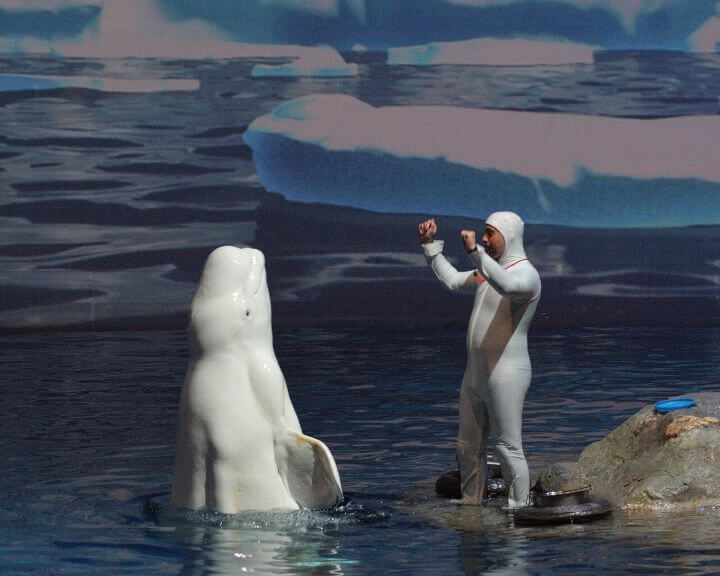
Photo of a beluga whale during a show at Shedd Aquarium – By Sage Ross via Creative Commons.
The deaths come as the captive marine mammal industry has portrayed and celebrated the transfer of Marineland Canada’s whales to facilities in the United States and Europe as an international “rescue.”
In 2021, when Marineland Canada shipped five beluga whales to the Mystic Aquarium in Connecticut, two of them died in the first six months.
The Whale Sanctuary Project is calling for full transparency about the health of whales transferred from Marineland, including what was known before transport, how animals were determined fit to travel and what additional safeguards are being taken for the surviving whales.
Facilities receiving whales from Marineland Canada must commit publicly that the animals will not be bred.
The fundamental failure of the captive whale industry to plan for the animals it captured, bred, and used for entertainment.
Crisis Not Limited to North America
Around the world, the captive whale industry is confronting the consequences of decades spent capturing, buying and breeding animals without any regard to what happens when facilities close, populations age, or keeping whales in captivity is no longer acceptable.
In France, Wikie and her son Keijo remain shuttered in Marineland Antibes in the South of France, caught by an industry determined to send them to another captive facility despite the French government having identified the Whale Sanctuary Project as the most credible, ethical and welfare-focused option. Their situation underscores the fundamental failure of the captive whale industry to plan for the animals it captured, bred, and used for entertainment. When facilities close, whales should not be left stranded for months or years while the industry searches for another set of concrete tanks willing to take them.
The Sanctuary Model
The Whale Sanctuary Project is building a seaside sanctuary in Nova Scotia to provide a fundamentally different future for whales who cannot be released into the wild: lifelong professional care in a natural marine environment, with the space and autonomy that no concrete tank can provide.
But building that alternative requires urgent financial support.
The sanctuary is under construction, and the Whale Sanctuary Project is calling on philanthropists, foundations and people around the world who care about whales to help now so that it can be ready to receive animals.
“We know there is a better way, and we are building it,” added Marino. “But we need people who are appalled by what they are seeing to help us finish this sanctuary. If we want to stop this endless cycle of whales being trafficked from tank to tank, we have to build somewhere better for them to go.”
The deaths at Shedd and the continuing plight of Wikie and Keijo should make the urgency painfully clear.
The choice now is whether we allow the industry to keep shuffling whales between captive facilities or build the infrastructure necessary to finally break that cycle.
How many more whales must die in captivity around the world before we fundamentally rethink what their future should look like?
Moving whales from one concrete tank to another cannot be the long-term answer.
# # #
Title photo by Sasha Rink/World Animal Protection