Over the last few weeks, we’ve been hearing a lot about the “emergency rescue” of 30 surviving beluga whales at the theme park/zoo Marineland Canada by a consortium of SeaWorld parks, along with other aquariums in the United States.
While these transfers are portrayed by the captivity industry as benevolent outreaches serving purposes of rescue, conservation and education, a closer look reveals that the cetacean (whale and dolphin) captivity industry in the United States has much to gain from importing these whales. (Two are now slated to go to Oceanogràfic, an aquarium in Valencia, Spain.)
They will be allowed to breed more whales
The Memorandum of Understanding that SeaWorld, the Shedd Aquarium in Chicago and the Georgia Aquarium have signed with NOAA (the U.S. National Oceanic and Atmospheric Administration) is conspicuously missing any agreement by the facilities not to breed these whales. By contrast, in 2019, when Marineland Canada exported five beluga whales to the Mystic Aquarium in Connecticut, breeding was not permitted.
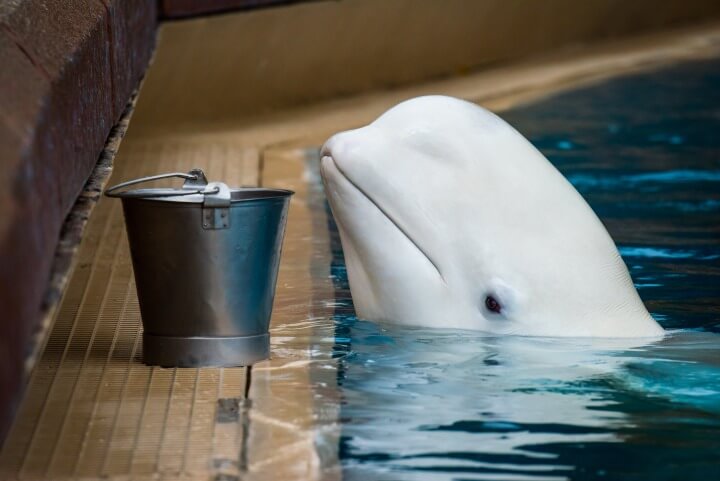
Photo of a beluga whale being fed at Marineland Canada. Photo by Dreamstime.
And even though Canadian law expressly forbids the use of whales and dolphins for entertainment or breeding, the Canadian government required no such agreement before signing off on the export of the whales.
As Animal Justice, Canada’s premier animal law advocacy organization, explains the situation:
“When Canada passed groundbreaking laws in 2019 banning whale captivity and breeding, the promise was that this would be the last generation of whales to experience the misery of captivity. Instead, we’re simply exporting the suffering abroad and allowing it to continue.”
Marineland was threatening to kill them
Why, then, did both governments quietly give a green light to these beluga whales being used for breeding? The answer, most likely, is that without this agreement the captivity industry would be a lot less interested in importing them.
“We’re simply exporting the suffering abroad and allowing it to continue.”
The Canadian government had found itself in an awkward situation with Marineland Canada threatening publicly to kill any belugas that it could not otherwise get rid of. Marineland was claiming to be in a financial crisis and unable to care for the whales any longer. But the approximately 1,000-acre property they have put up for sale is considered to be worth hundreds of millions of dollars.
Marineland has also repeatedly refused to consider the sanctuary option and to at least care for the whales until the Whale Sanctuary Project can finish construction of the sanctuary in Nova Scotia.
And so, the deal was done. And the industry has successfully spun the narrative that this is simply an “emergency rescue” rather than also an opportunity to restock its American facilities.
Will the whales be better off in their new tanks?
Considering that Marineland was threatening to kill them, the whales will certainly be better off in that they are, at least, still alive! But that’s a pretty low bar: removal from one concrete tank to another, one form of enforced captivity to another.
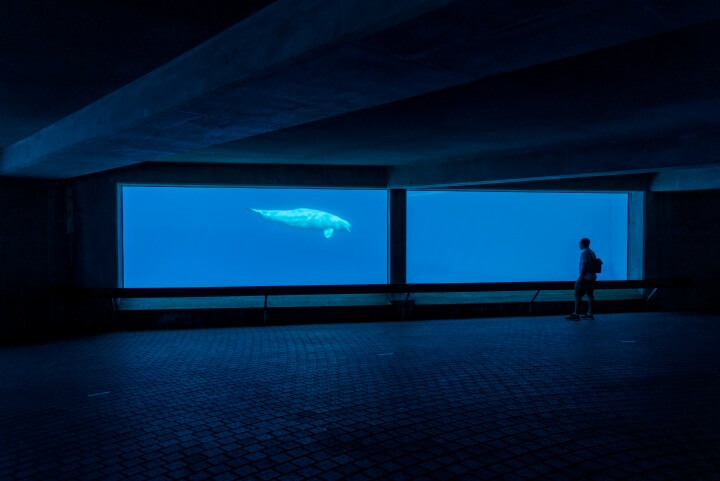
Photo of captive beluga whale at Marineland Canada by Sasha Rink/World Animal Protection.
For these whales and for any others – whether taken captive in the wild or born in a tank, never to know anything beyond its concrete walls – it can only ever be, at best, just a better prison.
As Animal Justice sums up this whole miserable episode: “It’s not a rescue, it’s government-enabled whale trafficking.”
The bottom line: It’s whale trafficking
What do we mean by “trafficking”?
The United Nations Protocol to Prevent, Suppress and Punish Trafficking in Persons, Especially Women and Children defines trafficking as:
(a) […] the recruitment, transportation, transfer, harboring or receipt of persons, by means of threat or use of force or other forms of coercion, of abduction, of fraud, of deception, of the abuse of power or of a position of vulnerability or of the giving or receiving of payments or benefits to achieve the consent of a person having control over another person, for the purpose of exploitation.
And the U.S. Department of Justice, which focuses on human trafficking, notes that trafficking victims are “lured or forced into situations where they are made to work under deplorable conditions with little or no pay” and that “traffickers can be pimps, gang members, diplomats, business owners, labor brokers, and farm, factory, and company owners.”
Just as persons of a different gender, race, age etc. can be victims of trafficking – bought, sold, used and abused for pleasure and profit – so can those of a different species.
Whales and dolphins are no less intelligent and emotionally sensitive than we humans. They live in closely bonded families, just like us. They care for their young and grieve their lost ones, just as we do. To take them from their families and sell them, loan them, trade them, enslave them, breed more of them, and exploit them for profit is a crime against nature, just as it is when committed against the young and innocent of our own kind.
We call it what it is: trafficking. And it is time to bring this whole sorry episode in our history to an end.
# # #