Today, along with millions of other people around the world, we mourn the passing of Dr. Jane Goodall. What more can be said of anyone than the simple fact that they made the world a better place for all living creatures?
Dr. Goodall’s discovery in 1960 that chimpanzees make and use tools rocked the scientific world and redefined the relationship between humans and animals.
 On learning of her evidence that we humans are not the only creatures capable of making and using tools, the preeminent paleoanthropologist Louis Leakey famously remarked: “Now we must redefine ‘tool,’ redefine ‘man,’ or accept chimpanzees as humans.”
In 1977, she established the Jane Goodall Institute to advance her work around the world for generations to come. Throughout the 1970s she made known her opposition to capturing wild chimpanzees for display in zoos or for medical research. And in the years that followed, she made the same case for scores of other megafauna.
“She was able to get to know chimpanzees because she approached them with the respect they deserved,” says Dr. Lori Marino, President of the Whale Sanctuary Project. “She had an innate understanding of how she needed to relate to them, which was that she was in their home. She followed their lead, and she let them tell her when they were ready to take the next step. And that’s what they responded to.”
She followed their lead, and she let them tell her when they were ready to take the next step.Much is being said about Dr. Goodall’s extraordinary life and work. But we must take special note here of her recent work for whales and dolphins. She consistently spoke out against the confinement of cetaceans (whales, dolphins and porpoises) in marine parks and aquariums, emphasizing the psychological and physical harm caused by captivity.
A year after passage in Canada of Bill S-203, The Ending the Captivity of Whale and Dolphins Act, she lent her name to a second bill, The Jane Goodall Act, to strengthen the provisions of S-203 and expand protections to elephants, great apes and other wild animals in captivity.
In January 2023, she issued a video message urging the Flemish Minister for Animal Welfare to end dolphin captivity and breeding at Boudewijn Seapark.
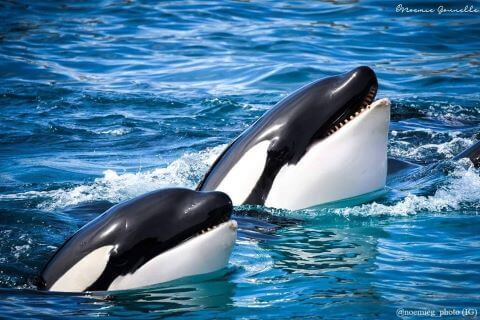 A year later, in February 2024, as the plight of the mother-and-son orcas Wikie and Keijo became known to the public, she wrote to the French Minister of Ecology recommending that they be retired to the sanctuary we are establishing in Nova Scotia: “A sanctuary environment will provide them with their first-ever opportunity to live out their lives in a stimulating environment where they have the space they need to swim and dive, and, most importantly, to begin to have a level of autonomy and choice in how they spend their days. I recommend that the Ministry do all possible to ensure that these orcas can be moved to the cetacean sanctuary in Nova Scotia.”
While she was clear-eyed about the harm that we humans are inflicting on our fellow animals, Dr. Goodall always believed that young people today can be a force for change – just as she was at their age. In 1991, in Tanzania, she launched Roots and Shoots, an organization that began with 12 students and has grown to become a global movement to empower youth to use their voices and ideas to address issues that matter most to them in their own communities.
In honoring her work, we can perhaps best simply echo the words of her colleagues at the Jane Goodall Institute in saying that “She blazed the trail … the rest is up to us.”