“Our SeaWorld family is mourning the loss of one of our beloved killer whales, Katina. … For many wonderful years, Katina awed and inspired millions of our guests to appreciate and learn more about this amazing species. This is an incredibly difficult time for those who knew and loved Katina. We appreciate the support of the community as we grieve her loss together with her loyal fans everywhere.” (From SeaWorld’s farewell to the orca Katina.)
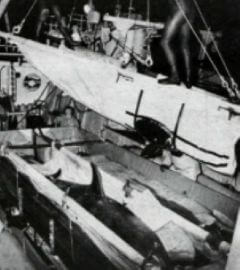
Katina was born in Icelandic waters about 48 years ago and wrenched from her family In October 1978 when she was approximately two years old. She was shipped to Marineland Canada, and then to various SeaWorld theme parks, for a total of 14 transfers ending up at Sea World Orlando in 1984, where she performed for the rest of her life before dying on December 21st, 2025, at age 50.
In the ocean, mothers and daughters spend a lifetime together. At SeaWorld, Katina would give birth to seven calves, most of whom would be taken away from her.
In 1985, she delivered her first calf, Kalina, who was taken from her at age 5 and shipped to another SeaWorld theme park, then transferred back to Orlando two years later, and then transferred yet again. Kalina was only 25 when she died in 2010.
Shortly after she had given birth to Kalina, Katina was impregnated again, and in 1988 she gave birth to a second daughter, Katerina. Mother and daughter had two and a half years together before the youngster was flown to Sea World Ohio in 1991, and from there, three years later, to Sea World San Antonio where, at the very young age of 10, she died of bacterial pneumonia, the most common cause of death in captive cetaceans.
In 1993, Katina gave birth to a son, Taku, whose father was Tilikum. Thirteen years later, when he reached sexual maturity, Taku impregnated his mother, resulting in an inbred calf, Nalani. In the wild, incest among orcas is unheard of. It is as aberrant as it is among us humans, and a behavior that is emblematic of the highly artificial and abnormal conditions imposed on captive orcas.
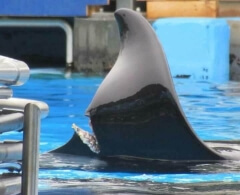
In 2018, Katina sustained a severe injury to the base of her dorsal fin. The wound was a deep gash that left part of her already-collapsed dorsal fin misshapen, leaving her open to opportunistic infections. The injury was either caused by an aggressive interaction with another orca or by landing on a sharp or hard part of the tank. We will never know.
What we do know, however, is that the captive environment contributed to her injury. In the ocean, orcas can certainly behave aggressively toward each other, but it is minimized because the whales can just disperse as far as they need to in order to dissipate tension. Being confined in a concrete tank, by comparison, leaves little if any opportunity for the orcas to space themselves in order to lessen hostilities. And there are no hard ledges and metal gates in the ocean; only in captivity.
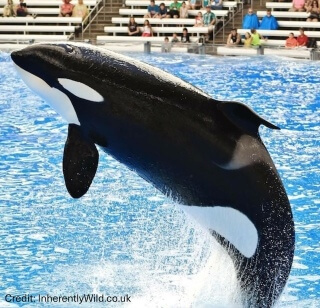
Katina was highly intelligent and sweet-natured. As an orca who had lived in the ocean with her own family, even if only for her first two years, she had learned enough to be able to nurture not only her calves, but also, whenever she was given the opportunity, the other orcas with whom she shared the tank. With her expansive personality, had she not been captured from the wild, she would likely have become the matriarch of her oceangoing pod. Instead, she became effectively the matriarch of the unnatural pod of orcas with whom she lived at SeaWorld Orlando.
Katina was considered a “successful” captive orca by SeaWorld because she spent so many years performing spectacular tricks for audiences. She was used in this way almost every day of her life.
But there was nothing “successful” about Katina and her forced confinement. She was a slave who managed to cope under extreme circumstances – a fact that we should never forget. And rather than allowing her abuse to be glorified, we should use her life as a beacon for action to bring an end to the suffering of whales and dolphins in captivity.
###