By Jeff Foster, Whale Sanctuary Project’s Whale Transfer & Rehab Coordinator
On the morning of May 1st, four vessels—the Fortuna, Robin Hood, Arne Tesilius, and an accompanying barge—continued their steady northward passage into the North Sea. By the third day of transport, they had traveled more than 300 miles from Wismar Bay and were positioned roughly 45 miles north of Skagen, Denmark, marking a significant point in their ongoing journey.
May 1
An early morning briefing was held with Stefan the barge captain, the divers and boat crew to outline the operational plan for the day, which would include tagging the whale and a potential release later in the afternoon, weather permitting. The vessel crew emphasized that sea conditions were extremely rough. As a result, we were required to sign a liability waiver acknowledging that we would not hold the crew responsible for any injuries sustained during the tagging or release operations.
In addition, in-water safety protocols were developed by Jeff Foster, Anne Herrschaft the attending veterinarian, Mike Partica, Kyra Wadsworth, and the rescue divers. These protocols included limiting personnel access to the whale to those with experience working with marine mammals, following prior observations that some barge crew members were unable to consistently adhere to established safety guidelines around the whale. An agreement was signed by Jeff and Stefan designating that Jeff was the lead for all whale-related operations, while Stefan was assigned responsibility for overseeing the barge and safety crew.
At approximately 10:00 AM, as soon as they arrived at the barge, Jeff, Mike, Kyra, Anne, two divers and Stephan immediately conducted an assessment of the whale. Timmy exhibited multiple visible injuries consistent with the severe conditions experienced overnight. These included several lacerations on the anterior portion of the head, likely caused by contact with exposed bolts along the barge walls; additional abrasions on the head region and near the blowhole, likely due to contact with the straps holding the sandbags in the front of the barge; a scrape measuring approximately two feet along the right fluke; and a significant abrasion (“raspberry”) along the left lateral body measuring approximately one meter in length and half a meter in width.
Based on these observations, Jeff, Mike, Kyra and Anne expressed serious concern regarding the whale’s physical condition and ability to withstand another night aboard the barge, particularly given forecasts indicating worsening sea conditions as the vessel continued northward.
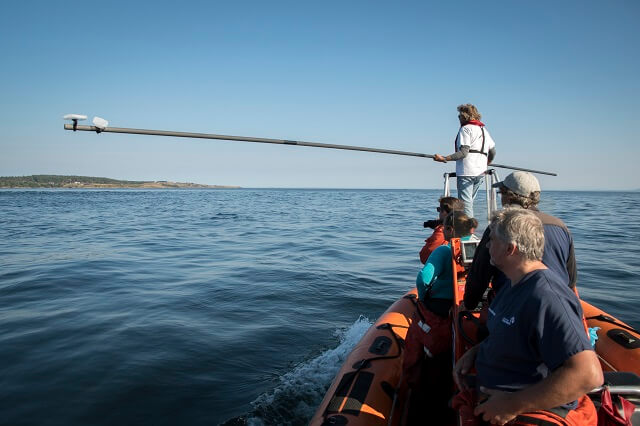
The tagging procedure proceeded under challenging conditions. The only tag that could be acquired in advance of departure from Insul Poel was designed for use on a seal and was therefore larger than appropriate for a humpback whale’s dorsal fin and had to be modified to fit Timmy’s dorsal fin. To adapt it, the team retrofitted the device using multiple cut sections of firehose secured with epoxy. Prior to departure, the team purchased the longest stainless-steel pins available, which were 3 inches in length. During the tagging application procedure only a single pin could be used to attach the tag to the dorsal fin because the dorsal fin was too thick in most parts for additional pins to be used properly.
Jeff, Mike, Kyra and Anne expressed serious concern regarding the whale’s physical condition and ability to withstand another night aboard the barge.
Conditions on the barge were rough, though the water level had been lowered enough to allow personnel to stand. Jeff, Mike, and Kyra entered the water with the tagging equipment, and Anne joined shortly afterward to remain near Timmy’s head to provide a calming presence. Due to limited accessibility, Jeff positioned himself on the whale just behind the dorsal fin to carry out the tagging procedure. Lassie, one of the divers, also entered the water to assist, while Mike made repeated trips between Jeff and Kyra to relay equipment.
The tagging process took approximately 30 minutes to complete and was ultimately secured. However, it was noted that the use of only a single attachment point could cause the tag to hang lower on the animal than intended, potentially affecting the consistency of satellite signal transmissions.
Following this, we formally requested permission from the barge crew, including divers Dan and Lassie, to remain with the whale due to concerns for its welfare. While permission was granted for us to stay onboard the barge, we were not permitted to enter the water.
As sea conditions continued to deteriorate, Timmy was observed expending significant energy attempting to stabilize and avoid repeated impact with the barge structure. Given Timmy’s existing injuries and increasing fatigue, our team strongly recommended initiating release procedures as soon as possible. However, we were informed that due to the vessel’s location within active shipping lanes, release would be delayed by at least one hour.
Jeff Foster in an earlier Whale Aid program preparing to take a breath sample from an orca (Photo by Katy Foster)
Jeff, Mike, Kyra, and Anne evaluated potential methods for removing the whale from the barge. It became clear that Timmy’s length had initially been underestimated and that the whale was several meters too long to turn around within the confines of the barge. Multiple attempts by the whale to reposition itself had already been observed to be unsuccessful. The team also raised the water level within the barge to the maximum feasible height to determine whether additional buoyancy would enable Timmy to turn, but this also proved ineffective.
The option of using a net to extract the whale was considered and ultimately rejected for several reasons. The available nets were highly abrasive, and the size required for an animal of this scale would have been extremely difficult to manage manually. Additionally, standard practice avoids dragging a whale using mechanical force beyond human control. Given this whale’s existing injuries and elevated stress levels, there was significant concern about causing further harm, particularly to sensitive areas such as the head and eyes.
The captain made the decision to leave Timmy unattended during the night despite strong objections voiced by Jeff and other members of the whale rescue team.
Communication throughout this process was inconsistent and ineffective. Multiple individuals simultaneously issued directives, often disregarding established protocols and the whale rescue team’s guidance.
It was ultimately decided to suspend operations for the evening and reconvene the following morning because weather conditions were improving, and it was felt we could continue farther north with the whale, which ultimately was in Timmy’s best interest. The captain made the decision to leave Timmy unattended during the night despite strong objections voiced by Jeff and other members of the whale rescue team given their concerns regarding Timmy’s deteriorating condition and the risks associated with leaving Timmy unattended overnight. Notably, it is standard practice in such operations to maintain continuous (24-hour) monitoring of an animal; however, the whale rescue team was not permitted to do so, which caused significant concern.
Later that evening, a coordination meeting was held involving Jeff, the barge captain (Stefan), the captain of the tugboat Robin Hood, the captain of the Fortuna, which was the vessel towing the barge, and Howie, the first mate on the barge. A release strategy was discussed and agreed upon. The Fortuna captain stated that Jeff would be responsible for overseeing the release operation. The agreed method involved slowing the barge tow to a minimum speed, manually repositioning the whale toward the stern, and then, if necessary, using the tugboat to solely apply controlled drift force without power to guide the whale the remaining distance out of the barge before releasing all lines.
Jeff communicated to the rest of the whale rescue team that operations would commence at 7:00 AM the following morning, with the tugboat scheduled to retrieve them from the Arne Tesilius, the vessel on which the whale rescue team members were being housed.
* * *
May 2
At approximately 6:30 AM, a crew member on the Fortuna informed Jeff that the transfer to the barge process was already underway. Upon arriving on deck, Jeff observed that personnel were fully prepared and already mobilized aboard the tugboat Robin Hood. He was informed that the team was departing immediately to assess the whale but would return for the rest of the whale rescue team. Although initially considering waiting for the rest of his team, Jeff boarded the tugboat at the last moment to assess the health of the whale believing they would be returning for the rest of the whale rescue team after checking on Timmy. Weather conditions the previous night had been fairly rough, and he had concerns about the health of the whale.
During transit to the barge, disagreements arose regarding the methodology for handling and securing the whale. Jeff advocated for the previously agreed-upon approach; however, the tugboat captain, the barge captain and crew advocated and pressed for different methods.
Upon arrival at the barge, Jeff requested that the tugboat retrieve the remainder of the whale rescue team from the Fortuna and the Arne Tesilius to ensure a safe and properly coordinated operation. This request was denied multiple times by the tugboat captain. Jeff reiterated that he would not proceed without the full team, emphasizing that this was the only safe and responsible course of action.
The tugboat captain attempted to confiscate Jeff’s phone, threatening to discard it overboard.Jeff then attempted to confirm operational authority via radio communication. The captain of the Fortuna reaffirmed that Jeff was to direct the release operation. Despite this, the tugboat captain continued to refuse compliance. Communication barriers further complicated the situation, with conflicting instructions being issued in multiple languages. Not only were Jeff’s concerns for the whale ignored, but the captain and crew were insolent and contemptuous of his requests to follow the plan as previously agreed upon by which the personnel having the experience to care for the whale would execute the plan. Without the whale team present to execute the release plan, Jeff determined that he would not move to the barge and simply could not participate in what the barge captain and crew were doing.
Jeff requested that the Fortuna deploy its rubber boat to pick up staff and transport them to the barge but received no response. He then attempted to contact the rescue organizers to report that the situation was deteriorating. However, he was unable to reach them due to the lack of internet and cellular service.
Given these circumstances, Jeff again formally stated that he could not participate in what the barge captain and crew were doing. Not only were his concerns for the whale being ignored; the crew were openly disrespectful of his expertise. Jeff stated multiple times that he wanted the whole procedure called off, requesting that it be stopped. But his requests were ignored.
He then approached the captain once more, calmly stating that the situation was unacceptable and noting that it could potentially result in legal action from organizers. The captain responded nonverbally with a shrug, after which Jeff returned to the flying bridge of the tugboat, the Robin Hood.
Subsequently, Jeff observed from the tugboat as crew members—including individuals without marine mammal handling expertise—attempted to reposition and release the whale. One individual, Stefan, who only had minimal prior in-water experience with the whale, entered the water and attempted to maneuver him alone, without success.
Throughout the operation, guidance and safety protocols that the whale rescue team had previously provided to the crew were repeatedly disregarded. Crew members demonstrated a lack of understanding of the risks associated with interacting with a large marine mammal under stress.
During this time, Jeff began documenting the events. The tugboat captain intervened, attempting to confiscate his phone by grabbing his hand and then threatening to discard the phone overboard, stating that recording was not permitted. Jeff complied and ceased recording to avoid escalation.
The release attempt proceeded with multiple individuals (Stefan, Danny, Howie, and two others) manually securing lines to the whale’s fluke using a pike pole, which has a very sharp end with a hook. The soft tail-lines were secured to the whale and then attached to the tugboat. It was also observed that the Fortuna appeared to maintain a higher towing speed than agreed upon. As a result, the whale was forcibly dragged over sandbags within the barge with the pectoral fins fully extended, appearing to try to maintain stability while also causing visible distress.
The tugboat then seemed to apply reverse force, resulting in a rapid and uncontrolled extraction of the whale from the barge with the Fortuna pulling forward and the tugboat pulling in the opposite direction. This occurred significantly faster than the planned controlled release, raising further concerns about potential injury to the whale.
Several crew members privately expressed apologies for the manner in which the situation had been handled.
Once clear of the barge (approximately 30 meters), the whale was freed from the lines. Upon surfacing, Timmy appeared disoriented, initially taking a shallow breath before regaining some stability and taking a stronger breath.
After the release, Jeff returned to the lower deck of the tugboat. Several crew members privately expressed apologies for the manner in which the situation had been handled. Jeff did not engage further and remained silent during the return transit to the Fortuna. Upon arrival, he was given limited time to gather his belongings before rejoining the Arne Tesilius.
On the Arne Tesilius, Jeff briefed Mike and Kyra on the events that had occurred earlier that morning involving the Fortuna and Robin Hood. He expressed significant frustration and concern regarding the situation. It was also noted that none of the whale specialists had been able to assess Timmy that morning, leaving the team without updated information on the whale’s current condition, particularly given that conditions the previous night had been relatively rough.
The attending veterinarian Anne also joined the discussion and reiterated that no veterinary assessment of the whale’s health had been conducted, despite this being standard practice prior to a release. The situation left the team deeply concerned about the whale’s current physical and behavioral condition. After weeks of intensive effort to reach this stage, the outcome was especially disheartening and contributed to a strong sense of frustration among all involved.
* * *
May 16
Based on data from Timmy’s transmitter device, we know that the whale swam freely in the open ocean for several days, had multiple deep dives, including to a depth of 150 meters, indicating that Timmy was foraging for food. On May 15th, Timmy was located on the surface and, sadly, was found to have passed away.
# # #