This is the second in a series of posts about our work in the first quarter of 2024, which has been driven by the urgent need of two orcas at Marineland Antibes in France – Wikie and her son Keijo.
Given the urgency of the situation facing Wikie and Keijo, earlier this year we adopted an accelerated approach to complete the sanctuary on a timeline that will enable them to be brought to the sanctuary in mid-2025. The plan involves expedited construction of a large bay pen in advance of the completion of the full sanctuary.
On April 30th, we submitted to the French government our extensive “Expression of Interest”, detailing the mission and history of the Whale Sanctuary Project; the location of the sanctuary site, including the results of environmental studies required by regulatory agencies; infrastructure and facilities; a complete operational plan for every stage of transferring the whales to the sanctuary; financial plan; and regulatory and government engagement.
While the French government continues their assessment of the best future for Wikie and Keijo, we are pressing ahead with our plan to be able to welcome whales as soon as possible. Regardless of the outcome of the government’s decision, everything in this plan can be applied to any orcas or beluga whales coming to the sanctuary from anywhere in the world.
In the video above, Charles Vinick, Executive Director of the Whale Sanctuary Project, describes how the team is constructing a bay pen to accommodate whales being retired from entertainment parks.
The bay pen: The key element in this plan is a large bay pen that will be installed within the 100-acre water space of the sanctuary as the initial home for the orcas while the full one-mile perimeter net that surrounds the 100 acres is completed. Once the perimeter net is complete and the orcas have acclimated to their new environment, they will be released into the wider sanctuary space.
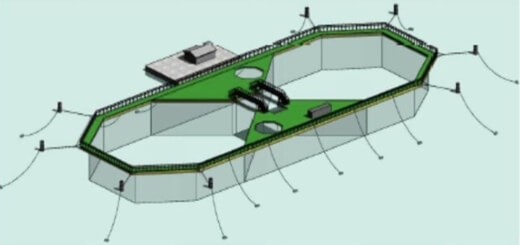
The design for the bay pen. (Note: The area of the bay pen will be more than four times the space they have at Marineland Antibes.)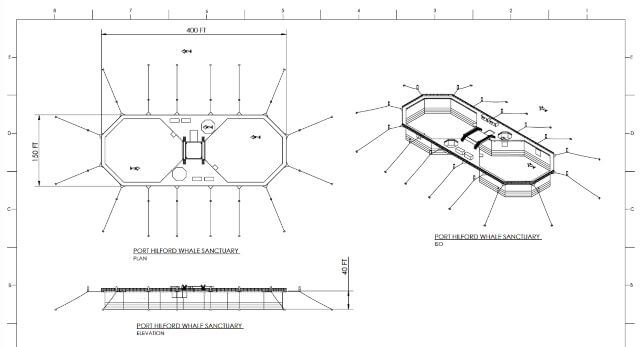
The bay pen is a net-sided structure, 400 feet by 150 feet, that will consist of two octagonal enclosures joined together to form a figure eight, with a medical lift in the center. This configuration allows for the partitioning of portions of the overall pen when needed, such as during the initial introduction to the space. But other than when the medical lift is in use, the gates on either side of it will remain open so that Wikie and Keijo can freely roam the entire pen area.
The area of the bay pen will be more than four times the space they have at Marineland Antibes. Current specs for the net are that it will be made of 8-inch stretch mesh net, fabricated of Dyneema, an extremely strong, ultra-high molecular weight polyethylene. It will be held in place vertically in the water by high-density polyethylene (HDPE) flotation pipes expressed on the surface with an integrated walkway on top of the pipes and heavy chain at the base of the net, where the net contacts the sea floor.
An additional horizontal lead line woven into the lower portion of the net will serve to keep the net taut through changes in daily tides.
In the diagrams below, you can see the approximate size of the bay pen as compared to the total area of space that Wikie and Keijo have at Marineland Antibes. And the 100 acres of overall sanctuary space will be more than 260 times the space they have there.
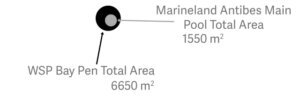
The size of the bay pen (the black disk) compared to the space that Wikie and Keijo have at Marineland Antibes (the gray disk).
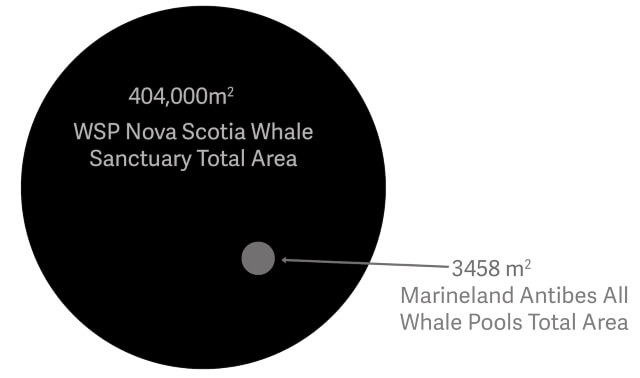
The 100-acre sanctuary space compared to the 0.85-acre space they have at Marineland Antibes.
The middle sections of the bay pen contain platform areas, including a slide-out, for the daily care of the whales and the medical lift. The platforms also include storage space for equipment, food, overnight staff bunk space, and toilet facilities. There are also two isolation pools for medical care. The integrated walkway around the perimeter of the bay pen provides staff with access to the orcas from all sides and provides for multiple feeding stations.

Regarding the permanent land-based facilities, we are currently assessing whether we can complete them all on the schedule for the whales or whether temporary facilities may be needed.
With this plan, Wikie and Keijo can have a new home at the sanctuary in 2025 while the perimeter net enclosing the full 100 acres of sanctuary waters and all infrastructure are being completed.
And once Wikie and Keijo have moved out of the bay pen into the full sanctuary area, the bay pen will be used to welcome other whales to give them time as needed to adapt to their new home, along with regularly scheduled husbandry and medical care as needed for any of them.
Next: Site Geography and Environmental Analyses.