Beluga Whales at Marineland Canada
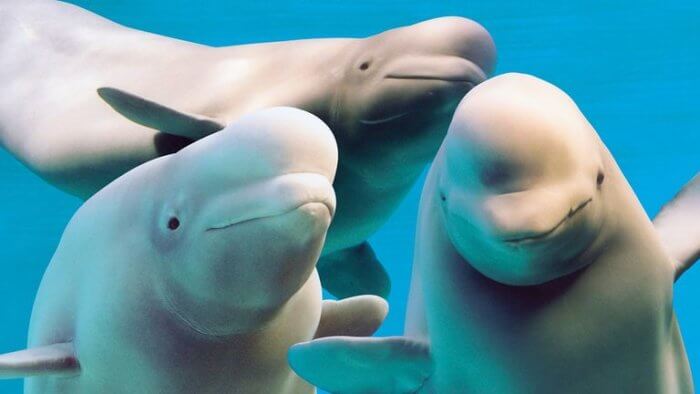
At time of this posting, there remain 30 beluga whales at Marineland Canada. Over the years a total of 88 belugas have spent all or part of their lives at the now-shuttered theme park. Of those 88, 36 were captured from the ocean off the east coast of Russi; the other 52 are their children or grandchildren.
Of the 36 who were captured from the ocean, 15 are still alive. The oldest is probably Gemini, captured in 1999. Of the 52 who have never known life outside of a concrete tank, 15 are also still alive. The oldest, Jellybean, is about 18 years old; the youngest, Rain, was born in 2019, just as the Canadian government was passing the Ending the Captivity of Whales & Dolphins Act, which bans further breeding of captive whales and dolphins.
Skyla and Skoot
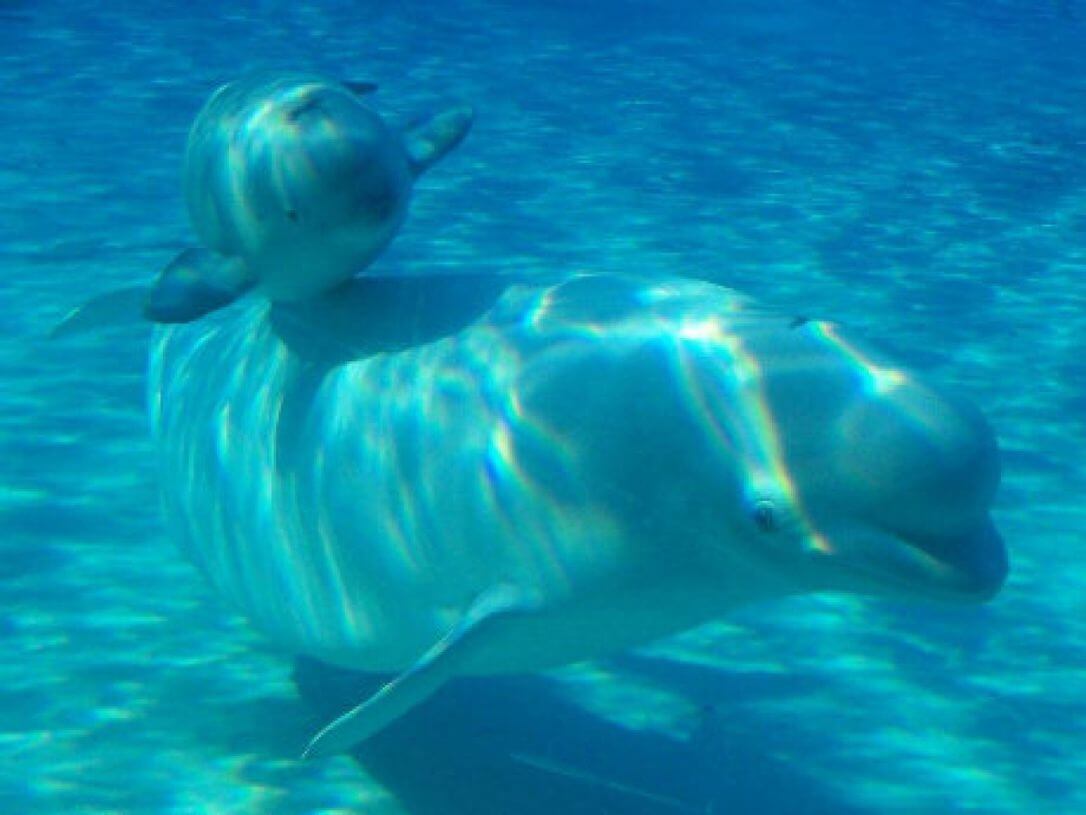
Perhaps the most shocking of all the deaths was Skoot, who was born at Marineland in 2011 and died a few months later after being attacked by two older males, Andre and Orion. In the ocean, when young males become aggressive, the whales they are harassing can easily just swim away. But that’s not what happens in the confines of a concrete tank.
Skoot’s mother Skyla tried to save her calf, pushing her toward a junior staff member and trying to stop Orion. But by the time trainers arrived to help, the damage was done. Together, they pulled Skoot from the water and “held her through her convulsions and mini seizures until she finally died in our arms.”
The full story of what happened that evening in 2012 was told to the Toronto Star by Jamie Charron, the staff member who witnessed it. The article is still online, and a short version is in our own post here.
Jetta, Havana, Kharabali, Havok and Sahara
On Friday May 14th, 2021, three beluga whales from Marineland Canada – Jetta, Havana and Kharabali – were loaded onto a C-130 Hercules cargo plane at Hamilton International Airport and flown to Groton Airport in Connecticut for a short drive to the Mystic Aquarium. Later in the day, two more belugas – Havok and Sahara (a male and a female) – would follow them.
It had been a problematic transfer. Three of the five whales had been deemed too sick to travel, so three others had been swapped in to take their place. And six-year-old Havok’s transport had already been postponed several times to allow his gastric ulcers to heal sufficiently for travel. But less than three months after he arrived at Mystic, Havok died of a preexisting “gastrointestinal condition.”
Six months later, Havana would die, and Kharabali would survive another 22 months until December 2023.
Beluga whales, like orcas, have strong and emotionally powerful relationships between mother and daughter.
Ten-year-old Jetta also became ill, but after receiving intensive care she recovered. Jetta is a daughter of Skyla, who was also the mother of Skoot (see Skyla and Skoot’s story above).
Beluga whales, like orcas, have strong and emotionally powerful relationships between mother and daughter. Family pods stay together for life, with mothers, sisters, aunts and grandmothers all raising and caring for their young together. For Skyla to have witnessed one infant daughter being murdered by her own uncle (Orion), and the other being lifted out of her tank by a crane, never to be returned, will have left her scarred for life.
Equally, to be that daughter, Jetta, forcibly removed from her mother and then set down in an entirely different tank, must have been emotionally and cognitively incomprehensible to her. Yet this is routinely the life of whales who live and die according to the financial needs of the entertainment industry.
At time of our writing this post, Marineland Canada continues to inform the government and the world that it can no longer care for the whales there. Meanwhile, the Whale Sanctuary Project is working with other humane organizations to find solutions for them. If it becomes necessary to place them at several different locations, we will ensure that family bonds between whales like Skyla and Jetta are fully respected, not ruptured.
###