Kiska: The Loneliest Whale in the World (1976-2023)
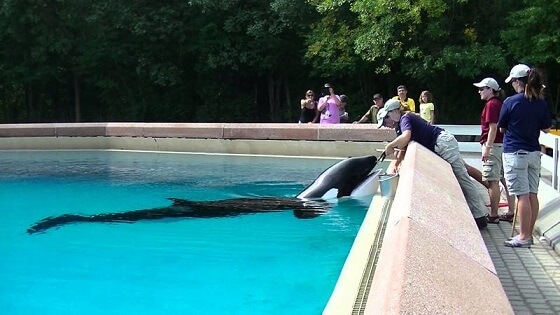
March 10th, 2023: Marineland Canada announced today that the orca Kiska has died of a bacterial infection. The news is devastating to all of us who have been working toward the time when she could be retired to sanctuary.
The following is her bio, as originally published here in 2018:
Kiska lives alone in a concrete tank at Marineland Canada. No family members swim by her side. No friends invite her to play. She holds the cruel distinction of being the only captive orca in North America held in social isolation from any other marine mammal.
Video footage and eyewitness accounts depict Kiska’s behavior as repetitive and lethargic. When not swimming in slow circles or bashing herself into the side of her tank, she often simply floats in place, staring at the emptiness that is the inside of her tank.
Captured in 1979 at around age three from the North Atlantic Ocean, she was taken to an aquarium in Iceland, where she was housed briefly with four other young orcas, including Keiko, the future star of the “Free Willy” movies. Shortly after, she was sold, along with Keiko, to Marineland. Keiko was then re-sold to an entertainment park in Mexico but would later be rescued, rehabilitated and returned to the ocean near Iceland. (Members of the Whale Sanctuary Project who took part in this rescue discuss Keiko’s remarkable story here.)
It is hard to imagine the grief and trauma of each of Kiska’s losses over the years.Meanwhile, at Marineland, Kiska gave birth, as a young adult, to five calves. All of them died young: Athena, Hudson, Nova, Kanuck and one who didn’t survive long enough to be named. Studies suggest that orcas’ capacity to feel deep, complex emotions rivals or even exceeds the emotional capacity possessed by humans. The bond between mother and calf is so deep that it is hard to imagine the grief and trauma of each of Kiska’s losses over the years.
The business of maintaining orcas
For marine entertainment parks, the death of a calf is a business loss. So, in 2001, when Kiska was about 25 years old and with no surviving males by whom she could be bred again, Marineland approached Busch Gardens, at that time the owners of SeaWorld, about the possibility of acquiring a male orca.
Busch Gardens, which had been looking for some beluga whales, offered to make an agreement whereby one male orca from a SeaWorld facility would be loaned to Marineland in exchange for four beluga whales. Marineland said it wouldn’t go higher than three. Busch Gardens insisted on four but finally offered to throw in a couple of SeaWorld’s trained sea lions. And so the deal was done.
The contract stipulated that the two companies would alternate ownership of baby whales.Shortly thereafter, Ikaika, a four-year-old orca at SeaWorld Orlando, was flown to Marineland in Niagara Falls. Known as “Ike,” he was too young to breed, but the plan was for him to develop relationships with Kiska and another female orca and become a father in the coming years. The contract stipulated that the two companies would alternate ownership of baby whales.
Ike arrived at Marineland with dental problems, most likely from chewing on the metal bars of his pool, and he needed daily treatment along with antibiotics and pain medication. The expectation was for Marineland to keep up his treatments, but his teeth were going from bad to worse. In 2009, SeaWorld decided they could give him better care and said they wanted him back. But Marineland didn’t want to give him up.
As reported by the Toronto Star at that time, the dispute ended up in court. SeaWorld won, Marineland appealed and lost again, and Ike was shipped back to the United States.
Since that time, Kiska has lived alone in her concrete tank. Although still on display, she no longer performs for the public. According to Marineland officials, she “spends her golden years doing what she wants.”
A way forward for Kiska?
In June 2019, the Canadian Parliament voted overwhelmingly to pass Bill S-203, the Ending the Captivity of Whales and Dolphins Act, which phases out the captivity of cetaceans in Canada.
In February 2020, the Whale Sanctuary Project announced its selection of Port Hilford Bay, Nova Scotia, as the best site to create a seaside sanctuary for whales being retired from entertainment parks. The site would be an ideal retirement location for Kiska.
The sanctuary site would be an ideal retirement location for Kiska.Also in 2020, Parliament took up a second bill, S-241, The Jane Goodall Act, which strengthens the provisions of the earlier bill while extending them to other kinds of animals. As the bill works its way through Parliament, several Senators have specifically mentioned the urgency of retiring Kiska to the sanctuary. The bill’s preamble “observes that the Ontario Government has jurisdiction to grant civil standing to Kiska. This would allow for a court order in her best interests by her own right, such as relocation to the whale sanctuary planned at Port Hilford, Nova Scotia.”
At the end of 2021, the Whale Sanctuary Project had a discussion with Marineland about the possibility of transferring whales from their facility to the sanctuary at the appropriate time. The meeting was cordial and positive, and we even set some dates for further meetings. Three days later, however, the Niagara police charged Marineland with using whales and dolphins for entertainment purposes, which is prohibited under the Ending the Captivity of Whales and Dolphins Act. At that point, Marineland broke off further discussion with the Whale Sanctuary Project.
A year later, after several procedural court hearings, the Crown Attorney for the Region of Niagara announced that prosecution was not in the public interest and that he was dropping the charges, saying, “The Crown determined that a stay of these charges was appropriate.”
The closing of this case represents an opportunity for Marineland to reopen discussions toward retiring Kiska to sanctuary.
On February 7th, 2023, Mayor Jim Diodati of Niagara Falls confirmed to CHCH TV the possibility of a sale of Marineland and said the first priority for the city would be the care and safety of the animals.
Kiska’s bio originally ended with these words . . .
What would it mean for Kiska to see and interact with other whales again? To have a chance to make new friends, to hear another whale answer when she calls? Or simply to feel the ocean again at a sanctuary where she can explore the kind of rich environment she knew before she was captured more than 40 years ago? We look forward to her having an opportunity to discover the answers herself.
. . . to which we must now add:
Marineland Canada came under new ownership in Junen 2024. The loss of Kiska will only intensify the urgency of our team to help Marineland relocate the approximately 34 belugas and five dolphins who remain there. And we look to every available means to transfer as many as possible to sanctuaries.