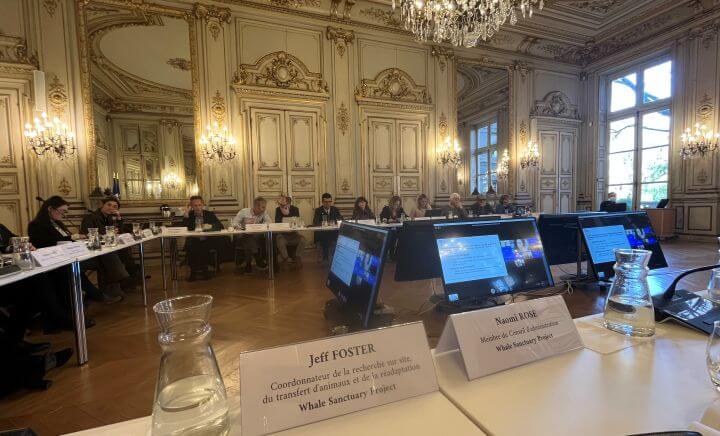
Last Monday, February 16th, at the Ministry of Ecological Transition in Paris, members of the Whale Sanctuary team met with members of the French government, along with the managements of zoos and theme parks, and several French animal welfare organizations.
The purpose of the meeting, Minister Mathieu Lefèvre said, was “to bring together all stakeholders” who are concerned with the future of the orcas Wikie and Keijo and the 12 dolphins at the now-shuttered Marineland Antibes. These stakeholders included “the operator, state representatives, scientific experts, associations, local elected officials, and potential care facilities.”
The Minister emphasized the government’s focus on “guarantees of animal welfare and safety” and “strict adherence to the legal framework established by the 2021 law,” which brings an end to keeping cetaceans (whales, dolphins and porpoises) in captivity in France for the purposes of entertainment.
Key people at the meeting were:
- Minister Mathieu Lefèvre, his chief Conseiller, Alexis Soiron, former minister Barbara Pompili, and other Ministry officials;
- Charles Vinick, CEO of the Whale Sanctuary Project (WSP); along with our President Dr. Lori Marino; Dr. Naomi Rose (senior scientist for marine mammal biology at the Animal Welfare Institute, and WSP board member); and Jeff Foster, WSP Animal Transfer & Rehab Coordinator;
- Pascal Ferracci, CEO of Parques Reunidos, which is the owner of Marineland Antibes;
- Rodolphe Delord and Delphine Delord, owners of Beauval Zoo in France;
- Martin Böye, scientific director for marine biology at Loro Parque zoo in Tenerife, Spain;
- Muriel Arnal, President of OneVoice France, along with veterinarian David Perpiñan;
- Members of other French animal welfare groups, including C’est Assez and Sea Shepherd France.
Part One: The 12 dolphins
The first part of the three-hour meeting was devoted to the 12 dolphins at Marineland Antibes, whom the owners of the Beauval Zoo are looking to acquire. The zoo is owned by the wealthy and politically influential Delord family, and Rodolphe Delord showed designs of a roughly 30-million-euro dolphin habitat that he portrayed as being akin to a sanctuary, in that there would be no shows. The dolphins would, however, still be on display and subject to breeding, both of which are incompatible with an authentic sanctuary and with the stated principles governing French law. Therefore, most French animal welfare organizations oppose transferring the dolphins to Beauval Zoo.
Part Two: The mother-and-son orcas Wikie and Keijo
The second part of the meeting was devoted to options for the two orcas Wikie and her son Keijo.
The Minister’s introduction included his confirmation and restatement that the whale sanctuary in Nova Scotia is the only option for Wikie and Keijo that is credible and in keeping with French law.
Whale Sanctuary Project CEO Charles Vinick gave a comprehensive presentation about the sanctuary and our four years of environmental studies, along with an overview of the plans for construction of the sanctuary enclosure, sanctuary buildings, bay pens, medical lift, etc. The team then answered questions that were primarily about the water temperature, the environmental studies, and the site’s ability to withstand severe weather events.
The presentation and Q&A were well received by almost everyone present; the main exception being members of the captivity industry, which is opposed in principle to any captive whales and dolphins being retired to sanctuary. The owners of Marineland are pressing for the orcas to go to Loro Parque zoo in the Spanish Canary Islands, which urgently needs to replenish its stock of orcas because four have died there since 2021. But rather than say this outright, they claimed that Wikie and Keijo will have better care at this zoo than at a sanctuary and that the water in Nova Scotia is too cold for orcas.
What is needed now to save these two orcas is the funding to have the sanctuary ready by the end of summer this year 2026.
The claim that the water is too cold is disputed by the fact that Wikie and Keijo are Icelandic orcas. Wikie’s mother and other family members were captured in Icelandic waters and are all adapted biologically and by evolution to a cold-water environment. Dr. Naomi Rose of the Animal Welfare Institute and veterinarian Dr. David Perpiñan provided scientific arguments to support our position that, with proper nutrition and conditioning, this will not be an issue. We also presented a statement from Dr. Jim McBain, retired VP of veterinary services for SeaWorld, saying that in his experience orcas adapt well to changes in temperature and that the temperatures of ocean waters in Nova Scotia are within the range that is appropriate for orcas.
Because the captivity industry sees the sanctuary as a threat to its business model, Wikie and Keijo have become the thin end of a potentially very large wedge. Beyond Marineland, Parques Reunidos also owns about 60 other parks and is itself owned by powerful investment groups, whose primary interest is in profit rather than animal welfare. For that reason, they are aggressively trying to keep the two orcas from being transferred to the sanctuary in Nova Scotia and even to prevent this sanctuary from being established at all.
The Minister pressed for Parques Reunidos, the owners of Marineland Antibes, to sit down for discussion with our team. But the owners were unwilling even to engage in discussion with us. And at the end of the meeting, the Minister announced a new deadline, the end of March, when it expects to make a final decision as to where Wikie and Keijo will go.
The Bottom Line: Funding
French law prohibits Marineland Antibes from transferring the orcas to another facility where they may be put on show or used for breeding. And from its first report, October 2024, when the ministry’s General Inspectorate called the Nova Scotia sanctuary “the most credible innovative solution among the sanctuary projects,” to its December 2025 announcement that “the park’s two orcas are destined to join the Whale Sanctuary Project, a marine sanctuary for cetaceans in Nova Scotia, Canada,” the government has never wavered in its view that the best outcome for Wikie and Keijo is the sanctuary in Nova Scotia.
The challenge is no longer to do with objections that have been raised and fully refuted. What is needed now to save these two orcas is the funding to have the sanctuary ready by the end of summer this year, 2026.
If we can demonstrate that we have a confirmed path to the funding to be able to welcome Wilkie and Keijo by the end of summer, then the Ministry will be able to bring Parques Reunidos (the owners of Marineland Antibes) to the table to meet with us.
If we cannot provide evidence of immediate funding and a path to sufficient sanctuary construction funding to be able to take the orcas, Wikie and Keijo will likely end up in Loro Parque zoo, where they will continue performing and will be fully exploited in the zoo’s breeding program.
The stakes are high and time is short. While we have the funds to begin construction at the sanctuary site immediately, we do not yet have the funds to complete it.
Anything that a visionary donor or foundation can do to close this funding gap by the end of March will make a big difference. The result will not simply be a new life for Wikie and Keijo, but clear evidence around the world that the laws in France and Canada are truly taking effect and that the global exploitation of whales is, at last, an endangered industry.
